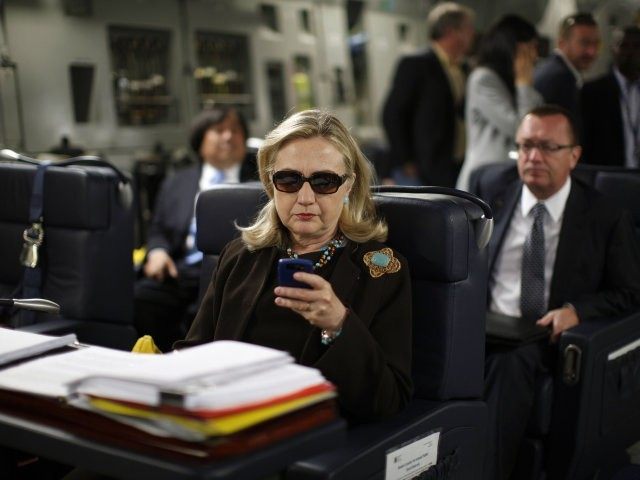
Hillary Clinton’s
Off-the-Books Mail Server Was in Her House, Registered to a Non-Existent Man
by John Hayward4 Mar 2015
Stage 2 of the Hillary email scandal has been achieved,
as yesterday’s “confused old lady who didn’t understand how email works”
defense utterly collapsed with the Associated Press’
discovery that Clinton’s mail server was located in her house (her
estate in Chappaqua, to be exact — the one she had to settle for because she
was “dead broke” after Bill left office) and was registered under the name of a
man who does not appear to exist.
To their credit, liberal media figures
quickly realized
this wasn’t a story that could be waved away with a laugh, some standard Obama
Administration pabulum about how much this furtive crew values transparency,
and a few whiny stories about how Republicans were known to use private
email, too. (ABC News didn’t get the message, so they
launched an abortive attempt
to protect Hillary by taking a poorly-researched swing at the Gmail address on
the business card of Rep. Jason Chaffetz of Utah, completely missing the point
that Hillary routed
all of her correspondence through her
personal email address, and Chaffetz isn’t subject to the Freedom of
Information Act laws that govern the Secretary of State. Five minutes of Google
time would have saved these Democrat-operatives-with-bylines a
ton of
embarrassment.)
Chaffetz also isn’t running a questionably secure secret
mail server out of his basement.
Yesterday we learned
that Hillary registered her off-the-books mail domain on the
very
day her Senate confirmation hearings began, which is a rather
significant clue that she knew exactly what she was doing. This morning the AP
brings us more details:
The computer server that transmitted and received Hillary
Clinton’s emails — on a private
account she used exclusively for official business when she was secretary of
state — traced back to an Internet service registered to her family’s home in
Chappaqua, New York, according to Internet records reviewed by The Associated
Press.
The highly unusual practice of a Cabinet-level official physically
running her own email would have given Clinton, the presumptive Democratic
presidential candidate, impressive control over limiting access to her message
archives. It also would distinguish Clinton’s secretive email practices as far
more sophisticated than some politicians, including Mitt Romney and Sarah
Palin, who were caught conducting official business using free email services
operated by Microsoft Corp. and Yahoo Inc.
Most Internet users rely on professional outside companies,
such as Google Inc. or their own employers, for the behind-the-scenes
complexities of managing their email communications. Government employees
generally use servers run by federal agencies where they work.
In most cases, individuals who operate their own email
servers are technical experts or users so concerned about issues of privacy and
surveillance they take matters into their own hands. It was not immediately
clear exactly where Clinton ran that computer system.
Clinton has not described her motivation for using a private
email account — hdr22@clintonemail.com, which traced back to her own private
email server registered under an apparent pseudonym — for official State
Department business.
Operating her own server would have afforded Clinton
additional legal opportunities to block government or private subpoenas in
criminal, administrative or civil cases because her lawyers could object in
court before being forced to turn over any emails. And since the Secret Service
was guarding Clinton’s home, an email server there would have been well
protected from theft or a physical hacking.
But homemade email servers are generally not as reliable,
secure from hackers or protected from fires or floods as those in commercial
data centers. Those professional facilities provide monitoring for viruses or
hacking attempts, regulated temperatures, off-site backups, generators in case
of power outages, fire-suppression systems and redundant communications lines.
“Well-protected from theft or a physical hacking?”
None of the big hacking crimes of the last few years have involved the
miscreant actually slipping into the server room wearing Groucho glasses and
escaping with a huge mail server tucked under his jacket. As the AP goes on to
concede, we still don’t know much about how truly secure Clinton’s
mail server was, or exactly what she was sending through it. And it will be
tough to ask the man nominally in charge of it, because he apparently doesn’t
exist:
It was unclear whom Clinton hired to set up or maintain her
private email server, which the AP traced to a mysterious identity, Eric
Hoteham. That name does not appear in public records databases, campaign
contribution records or Internet background searches. Hoteham was listed as the
customer at Clinton’s $1.7 million home on Old House Lane in Chappaqua in
records registering the Internet address for her email server since August
2010.
The Hoteham personality also is associated with a separate
email server, presidentclinton.com, and a non-functioning website,
wjcoffice.com, all linked to the same residential Internet account as Mrs.
Clinton’s email server. The former president’s full name is William
Jefferson Clinton.
In November 2012, without explanation, Clinton’s private
email account was reconfigured to use Google’s servers as a backup in case her
own personal email server failed, according to Internet records. That is
significant because Clinton publicly supported Google’s accusations in June
2011 that China’s government had tried to break into the Google mail accounts
of senior U.S. government officials. It was one of the first instances of a
major American corporation openly accusing a foreign government of hacking.
Then, in July 2013, five months after she resigned as
secretary of state, Clinton’s private email server was reconfigured again to
use a Denver-based commercial email provider, MX Logic, which is now owned by
McAfee Inc., a top Internet security company.
We’ve learned one thing this morning about the enigmatic Mr.
Hoteham: he uses the
same P.O. Box as
the Clinton Foundation — subject of the
other big Hillary
scandal concerning foreign money donated while she was Secretary of State.
Rep. Trey Gowdy (R-SC) of the House
Benghazi Committee
revealed yesterday
that Hillary was using
more than one personal account. Were they
all running off her Chappaqua server? If not, how secure were the other servers
she used? As for the early Clinton spin that everyone she communicated with
inside the Administration was using a proper email account that would be
captured by the legally required archive systems, it turns out
two of her top aides
had off-the-books personal accounts too — one of them the aforementioned Huma
Abedin.
Even if the server was 100 percent secure, with protection
equivalent to the State Department system
Hillary was required by federal law to use, there’s still the
matter of how her off-the-books setup allowed her to easily evade FOIA
requests. The Associated Press mentions that it’s been waiting for more than a
year to get some State Department emails it requested.
The
New York Times, which
broke the Clinton email story based on information from the House Benghazi
Committee, today listed some other FOIA requests that appear to have been
thwarted by Hillary’s secret email system, including more details about the AP
request than the Associated Press saw fit to mention in its own story:
In 2013, Nitasha Tiku, then a reporter for Gawker, filed a
Freedom of Information Act request, seeking all correspondence on Mrs.
Clinton’s private email account between her and Sidney Blumenthal, a close
adviser and onetime staff member in the Clinton White House. Some of those
emails had already spilled into public view and been reported in the news
media. But the State Department told Gawker that it could find no records
responsive to the request, Gawker reported.
[…] In December, The Associated Press said its FOIA requests
for records related to Mrs. Clinton’s tenure at the State Department, the
oldest of which was submitted in March 2010, were not answered. In addition to
requesting Mrs. Clinton’s schedules, The A.P. asked for correspondence related
to Huma Abedin’s special arrangement to serve as a top adviser to
Mrs. Clinton and consult for private clients. “We have not received any
documents yet, despite the promised deadlines, and we are evaluating the
situation,” said Erin Madigan White, spokeswoman for The A.P.
Conservative groups have filed numerous requests for
information about Mrs. Clinton as she prepares for a possible presidential run.
Citizens United is expecting a court ruling on Friday about a lawsuit the group
filed last year after the State Department would not disclose flight records
that would have shown who accompanied Mrs. Clinton on overseas trips. The group
had intended to cross reference the agency’s flight manifests with the donors
who contributed to the Bill, Hillary & Chelsea Clinton Foundation.
The FOIA request was just one of 16 appeals the group has
made to the State Department since May that have gone unfulfilled. Those
requests also included specific correspondence from Mrs. Clinton and her
closest aides, including Cheryl D. Mills and Ms. Abedin.
America Rising, an anti-Clinton “super PAC,” has submitted a
dozen FOIA requests for State Department records beginning last June.
Requests included correspondence between Ms. Mills and
Clinton Foundation leadership and Ms. Abedin’s communication with members of Teneo,
a private consultancy partly run by Doug Band, a longtime aide to former President
Bill Clinton. Ms. Abedin had a special arrangement that allowed her to work at
the State Department and be paid by Teneo, which offers strategic advice to
major global corporations. America Rising also requested Mrs. Clinton’s
schedule during the annual Clinton Global Initiative gatherings in New York.
In all cases, the State Department acknowledged receipt of
the FOIA requests and assigned case numbers but did not produce any of the
requested documents. “Unfortunately, Clinton’s own political calculation and
desire for secrecy, as evidenced by her exclusive use of personal email
accounts while at State, is preventing an open process and full, fair review of
her time there,” said Jeff Bechdel, a spokesman for America Rising.
Another FOIA request directed at Hillary, from
Veterans
For A Strong America in 2012,
specifically requested
information on any personal accounts Clinton might have been using.
Of course, as Obama’s damage-control teams have always
understood, timing is everything; any story can be deflated, defused, and
discarded if vital details are kept hidden for long enough. The scandal
that would sweep a politician away on a tide of public outrage, if full
disclosure was achieved quickly, becomes “old news” and is eventually interred
in the mausoleum of footnotes if disclosure can be stretched out for long
enough. The media is well aware of this, which is why they produce white-hot
wall-to-wall coverage and keep stories bubbling with the “breaking news”
discovery of dubious facts or trivial anecdotes when a Republican is the
target.
Is that tactic going to work in this case?
We’re back to the same old lawless narrative of the Obama
years: the press is ultimately judge and jury when high Democrat officials
break the law, because the legal mechanisms that should restrain executive
power and hold the ruling class accountable have been completely disabled. All
the bluffs and gentlemen’s agreements that kept power in check have been called
and discarded. Obviously those who were given false answers to their FOIA
requests are angry (or, in the case of Democrat media organizations, querulous),
but in the end, it’s not clear what they can do about it, other than complain…
and eventually the Clinton-friendly media will stop relaying their complaints.
What are the odds that liberal royalty like Hillary Clinton would actually be
held
accountable and punished for a deliberate, elaborate
effort to evade federal law? Wouldn’t Obama halt any investigation
before it did real damage to her, the way his agencies have acted to
thwart investigation
of the IRS targeting scandal?
Maybe not.
While White House Press Secretary Josh Earnest did try to
peddle some flim-flam
about how both federal law and the Obama Administration’s much-touted
transparency requirements are really kinda sorta
optional for
important people like Hillary Clinton, he also
admitted that “very
specific guidance has been given to agencies all across the government, which
is specifically that employees in the Obama administration should use their
official email accounts when they’re conducting official government business.”
In the unusual situations where personal accounts could be used, “it is
important for those records to be preserved, consistent with the Federal
Records Act.”
This could be Team Obama backing off to a safe distance
before the Hillary email scandal detonates in a cloud of career-shredding
shrapnel. Maybe some people on the Obama team are not entirely sad to see
Hillary go down. Some of those people might be named “Obama.”
The bottom line is that our federal transparency laws are
not trifles to be settled by soap-opera personal conflicts, spin teams, or the
troubled consciences of Democrats in the media. It’s also not good enough to
tell voters to sit on their complaints until they get a chance to vent at the
ballot box in a couple of years. That goes double if Hillary’s scheme
compromised national security. We can’t be comfortable about that issue
until we know more technical details about all of the servers she and her inner
circle were using.
Hillary Rodham Clinton
Hillary Rodham
Clinton was the secretary at the
U.S.
Department of State for the
Barack
Obama administration,
Huma Abedin is her aide, is a founding chair for the
Georgetown Institute for Women, Peace and
Security, married to
William J.
Clinton, and a director at the
Bill,
Hillary & Chelsea Clinton Foundation.
Douglas
J. Band is a regent at
Georgetown
University, the president of the
Teneo
Holdings LLC, was a deputy assistant to the president for the
William J. Clinton administration, and
a counselor for
William J. Clinton,
and conceived; former board member for the
Clinton
Global Initiative.
William J. Clinton’s
counselor was
Douglas J. Band, the
president for the
William J. Clinton
administration, officiated
Huma Abedin’s 2010 wedding, was an adviser
for
Teneo Holdings LLC, is married
to
Hillary Rodham Clinton, the
founder for the
Bill, Hillary &
Chelsea Clinton Foundation, and the founding chairman for the
Clinton Global Initiative.
Huma
Abedin is
Hillary Rodham Clinton’s
aide,
William J. Clinton officiated
her 2010 wedding, a consultant for the
Bill,
Hillary & Chelsea Clinton Foundation, consultant for
Teneo Holdings LLC, and a senior
adviser to secretary for the
U.S.
Department of State.
Open
Society Foundations was a funder for the
Bill, Hillary & Chelsea Clinton Foundation, and the
Atlantic Council of the United States
(think tank).
George
Soros is the founder & chairman for the
Open Society Foundations, a co-chair, national finance council at
Ready for Hillary, the founder of
Soros Fund Management, a board member
for the
International Crisis Group, and
was the chairman for the
Foundation to
Promote Open Society.
Jon
S. Corzine was the chairman & CEO for
MF Global Holdings Ltd., and a funder for the
Bill, Hillary & Chelsea Clinton Foundation.
Frank
Giustra is a director & funder for the
Bill, Hillary & Chelsea Clinton Foundation, and a board member
for the
International Crisis Group.
Victor Pinchuk
was a funder for the
Bill, Hillary &
Chelsea Clinton Foundation, a board member for the
International Crisis Group, and attended
William J. Clinton’s 65th birthday party.
Zbigniew
Brzezinski was a board member for the
International
Crisis Group, and
Madeleine K.
Albright was his dissertation adviser at Columbia.
Madeleine K. Albright
was
Zbigniew Brzezinski’s dissertation
adviser at Columbia, is a professor at
Georgetown
University, an honorary director at the
Atlantic Council of the United States (think tank), and a trustee
at the
Aspen Institute (think tank).
Hillary Rodham
Clinton is a founding chair for the
Georgetown
Institute for Women, Peace and Security, married to
William J. Clinton,
Huma Abedin is her aide, a director at the
Bill, Hillary & Chelsea Clinton Foundation, and was the
secretary at the
U.S. Department of
State for the
Barack Obama
administration.
Thomas R.
Pickering is a co-chair for the
International
Crisis Group, a director at the
Atlantic
Council of the United States (think tank), a distinguished fellow at the
Brookings Institution (think tank), was
the chairman of review board that investigated the
2012 attack on U.S. consulate in Benghazi, Libya in 2013, and a lifetime
trustee at the
Aspen Institute (think
tank).
Cameron F. Kerry
is a fellow at the
Brookings Institution
(think tank), and
John F. Kerry’s
brother.
Teresa Heinz
Kerry is an honorary trustee at the
Brookings
Institution (think tank), and married to
John F. Kerry.
John
F. Kerry is
Cameron F. Kerry’s
brother, married to
Teresa Heinz Kerry,
the secretary at the
U.S. Department of
State for the
Barack Obama
administration, and a governor for the
Broadcasting
Board of Governors.
Condoleezza Rice was the secretary for the U.S. Department of State, a governor
for the Broadcasting Board of Governors,
Muammar Abu Minyar Al-Qadhafi said
he loved her & kept scrapbook of her photos, is a trustee at the Aspen
Institute (think tank), a director at the Atlantic Council of the United States (think tank), and a 2008 Bilderberg conference
participant (think tank).
J.
Christopher Stevens was the U.S. ambassador for
Libya, and was killed in the
2012
attack on U.S. consulate in Benghazi, Libya.
Thomas R.
Pickering was chairman of review board that investigated the
2012 attack on U.S. consulate in Benghazi,
Libya in2013, a lifetime trustee at the
Aspen Institute (think tank), is a co-chair for the
International Crisis Group, a distinguished
fellow at the
Brookings Institution
(think tank), and a director at the
Atlantic
Council of the United States (think tank).
Anthony C. Zinni
was a director at the
Atlantic Council
of the United States (think tank), and
Laurence
Pope’s political adviser.
Laurence
Pope’s political adviser was
Anthony
C. Zinni, and is the U.S. charge d'affaires for
Libya.
Togo
D. West Jr. is a director at the
Atlantic
Council of the United States (think tank), and was the secretary at the
U.S. Department of Veterans Affairs for
the
William J. Clinton administration.
Eric
K. Shinseki was a director at the
Atlantic
Council of the United States (think tank), and the secretary at the
U.S. Department of Veterans Affairs for
the
Barack Obama administration.
Open
Society Foundations was a funder for the
Atlantic Council of the United States (think tank), and the
Bill, Hillary & Chelsea Clinton
Foundation.
George
Soros is the founder & chairman for the
Open Society Foundations, a co-chair, national finance council at
Ready for Hillary, the founder of
Soros Fund Management, a board member
for the
International Crisis Group, and
was the chairman for the
Foundation to
Promote Open Society.
Donald
F. McHenry is an honorary trustee at
the
Brookings Institution (think tank),
and a professor at
Georgetown University.
Madeleine K.
Albright is a trustee at the
Aspen
Institute (think tank), and a professor at
Georgetown University.
Douglas
J. Band is a regent at
Georgetown
University, the president of the
Teneo
Holdings LLC, was a deputy assistant to the president for the
William J. Clinton administration, and
a counselor for
William J. Clinton,
and conceived; former board member for the
Clinton
Global Initiative.
Hillary Rodham
Clinton is a founding chair for the
Georgetown
Institute for Women, Peace and Security, married to
William J. Clinton, a director at the
Bill, Hillary & Chelsea Clinton Foundation,
Huma Abedin is her aide, and was the secretary
at the
U.S. Department of State for
the
Barack Obama administration.