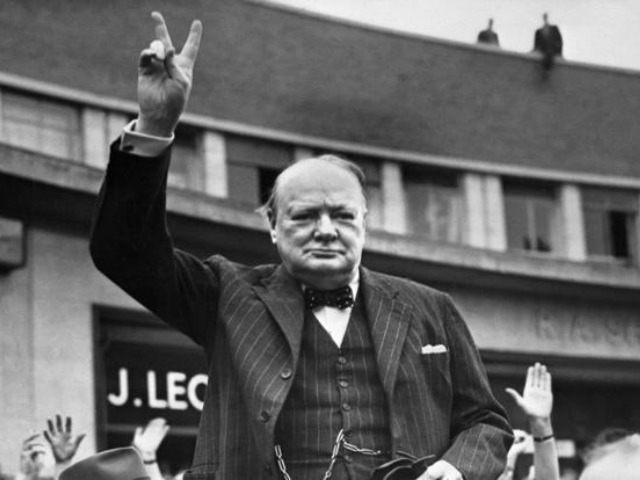
‘We Shall Fight on the Beaches’: Winston Churchill
Rallies the British Lion to Fight against Nazi Tyranny
by Jarrett Stepman 4 Jun 2015
Seventy-five years ago, Prime Minister Winston Churchill stood before Parliament and
delivered his “We Shall Fight on the Beaches” speech,
arguably the finest oration of his career.
Churchill had long warned of Adolf Hitler’s threat to the
free world and of Nazi Germany’s looming tyranny. He implored the people of Britain to
stand up to the Third Reich, and was convinced that his country, along with
their American cousins across the Atlantic, were the only hope to stop this
unquenchable evil. He warned the House of Commons in
1932, just months before Hitler took power, that the members should not “delude
themselves” into believing that Germany simply required equal status or a few
diplomatic concessions.
He noted the dangerous changes taking place in German
society.
“When we read about Germany, when we watch with surprise and
distress the tumultuous insurgence of ferocity and war spirit, the pitiless
treatment of minorities, the denial of the normal protections of civil society
to large numbers of individuals solely on the ground of race,” he said in a
1933 speech, “when we see that occurring in one of the most gifted, learned,
scientific, and formidable nations in the world, one cannot help feeling glad
that the fierce passions that are raging in Germany have not found, as yet, any
other outlet but upon Germans.”
At a time like that, Churchill was convinced the only policy
that could possibly keep the peace was maintaining the military strength of
Britain and its allies, but the leaders of Europe would have none of it and
could not conceive of another terrible war like the one that had ended in 1918.
When Churchill biographer Virginia Cowles met with Churchill
shortly before the war, he showed her a few stacks of papers that were part of
a manuscript for a history of the English-speaking peoples. “I doubt I shall
finish it before the war comes,” Churchill said glumly, “and if I do, the part
the English-speaking people will play will be so decisive I will have to add
several more volumes.” He added, “And if it is not decisive no more histories
will be written for many years.”
Churchill’s ascension to power on May 10, 1940, coincided
precisely with the German invasion of
Belgium and Holland, initiating its warpath
through Western Europe. This invasion ended the “
phoney war” period
of World War II marked by much tension and growing calls for peace. But this
was merely the quiet before the storm. Upon hearing the news of the sudden
German attack, Churchill met with Lord Halifax and Prime Minister Neville
Chamberlain in what Churchill called the “most important” interview of his
life.
The British government was in turmoil, and Chamberlain
conceded the country needed a more uniting and dynamic figure to lead the
nation in what was clearly becoming a massive and catastrophic war.
Churchill was informed in this meeting that the duty to lead the British people
must fall to him. This was the moment Churchill had been waiting for his entire
life.
During these last crowded days of the political crisis, my
pulse had not quickened at any moment. I took it all as it came. But I cannot
conceal from the reader of this truthful account that as I went to bed at about
3 A.M., I was conscious of a profound sense of relief. I felt as if I were
walking with Destiny, and that all my past life had been but a preparation for
this hour and for this trial.
The pugnacious Churchill had wandered in the political
wilderness through most of life, had been in almost perpetual war with party
establishments, and had almost always followed his passions and principles
rather that taking the safe path to leadership. The great man entered the arena
in the free world’s moment of greatest desperation, and he did not disappoint.
Never in history have the people of Britain been so solidly
behind a Prime Minister. Mr. Churchill did not fail them. At last the canvas
was high and broad enough to work on; at last his brilliant colours were needed
to depict the terrible and majestic glow on the horizon. He thrilled the
western world to its mission as no man could have done. … When he spoke of Man,
he was thinking of Mankind; and the future of Mankind hung in the balance.
In the month after Churchill became Prime Minister, the
German war machine stunned the world by quickly conquering most of Western
Europe and quickly setting the French Republic—which had fought tenaciously for
four long years during Great War—on the brink of collapse.
The events of May and early June of 1940 cleared all doubts
about what had to be done; appeasement of the Nazi regime had failed to secure
peace or security. The free people would now have to fight it out in what would
become the bloodiest war in human history.
The badly outnumbered British Expeditionary Force could do
little to stop the relentless advance of Hitler’s legions and had been making a
continual, hasty retreat. Trapped and perilously close to destruction, the BEF
launched Operation Dynamo, a daring and last ditch attempt to escape from continental
Europe at
Dunkirk. The
evacuation across the English Channel has gone into legend as the
nearly miraculous
deliverance of the seemingly doomed Allied army. Over 335,000 British, French,
and other European troops escaped to Great Britain, far exceeding even
Churchill’s wildest hopes.
Churchill historian Roy Jenkins
wrote, “The return
to home shores by a quarter of a million of the still small British army was of
hard practical importance.” He continued, “But it had even greater
psychological significance. It amounted almost to a regathering of the family
around the domestic hearth. It was Christmas come early in June.”
It was at the conclusion of this heroic effort that
Churchill decided to make an address to Parliament. Reminding his countrymen in
their exuberance that an evacuation was not a victory, he nonetheless—in
stirring fashion—gave an ultimatum to Germany that the British Empire, though
broken and bloodied, would never capitulate. He called on his people to fight
no matter what the cost. And ever the far-seeing statesman, he made sure to
exclaim at the end of his speech exactly from where the conquered people of
Europe would receive their deliverance. The
New World would have to “step
forth” and unleash its economic might in “liberation of the old.”
But the even greater evil, too often dismissed and ignored,
is the perpetual looming threat of the radical Islamist ideology that now
operates freely in the Middle East and, with increasing frequency, appears on
the soil of countries all over the world. Those who have
recognized this evil have
too often been derided and mocked. The free people of today have much to learn
from studying the life of Churchill, a great man who recognized the
dangers of allowing evil to
flourish and always stood for liberty and Western civilization.
Winston Churchill
Winston Churchill
was the prime minister for the
United
Kingdom, his grandson was
Winston
Churchill II, and he an attended the
Yalta
Conference.
Ed
Miliband is a member of the
British
Parliament, the leader of the
British
Labor Party,
David Miliband’s brother,
and was the energy secretary for the
United
Kingdom.
David
Axelrod is an adviser for the
British
Labor Party, the founder of the
AKP&D
Message and Media,
Rahm I. Emanuel’s
adviser, and was
Richard M. Daley’s
political adviser.
Rahm
I. Emanuel’s adviser is
David
Axelrod, his brother is
Ezekiel
Emanuel, the
Chicago (IL) mayor,
a member of the
Commercial Club of
Chicago, and was the White House chief of staff for the
Barack Obama administration.
Commercial Club of
Chicago, Members Directory A-Z (Past Research)
Tuesday, December 17, 2013
Richard
M. Daley is a member of the
Commercial
Club of Chicago, was
David Axelrod
was his political adviser, the
Chicago
(IL) mayor,
Michelle Obama was
his staffer, and
Valerie B. Jarrett
was his deputy chief of staff.
Michelle
Obama was
Richard M. Daley’s
staffer, a lawyer at
Sidley Austin LLP,
and is an advocate for the
ONE Campaign.
ONE
Campaign is a partner with the
International
Rescue Committee.
R.
Eden Martin is counsel at
Sidley
Austin LLP, and the president of the
Commercial
Club of Chicago.
Newton
N. Minow is a senior counsel at
Sidley
Austin LLP, and a member of the
Commercial
Club of Chicago.
James S.
Crown is a member of the
Commercial Club of Chicago, and a trustee
at the
Aspen Institute (think tank).
Foundation
to Promote Open Society was a funder for the
Aspen Institute (think tank),
the
Brookings Institution (think tank), the
Center for American Progress, the
International Rescue Committee, and the
Carnegie Endowment for
International Peace (think tank).
George Soros
was the chairman for the
Foundation to Promote Open Society, and a
supporter for the
Center for American
Progress.
Tom C. Korologos
is married to
Ann McLaughlin Korologos,
and was a U.S. ambassador for
Belgium.
Charles D. Powell
is a trustee at the
Aspen Institute (think tank), a member of the
House of Lords,
Margaret Thatcher’s private secretary & foreign affairs adviser,
and
John Major’s private secretary
& foreign affairs adviser.
Margaret Thatcher’s
private secretary & foreign affairs adviser was
Charles D. Powell, a member of the
House of Commons, and the prime minister for the
United Kingdom.
Lester Crown
was a lifetime trustee at the
Aspen Institute (think tank), and is a
member of the
Commercial Club of Chicago.
Valerie B. Jarrett
is a member of the
Commercial Club of
Chicago, the senior adviser for the
Barack
Obama administration, and her great uncle is
Vernon E. Jordan Jr.
Vernon E. Jordan
Jr. is
Valerie B.
Jarrett’s great uncle, a senior counsel for
Akin, Gump, Strauss, Hauer & Feld, LLP, an honorary trustee at
the
Brookings Institution (think tank), a director at the American
Friends of
Bilderberg (think tank), was the president of the
Economic Club of Washington, and a 2008
Bilderberg conference participant (think tank).
Alan
J. Blinken was a senior adviser for
Akin,
Gump, Strauss, Hauer & Feld, LLP, and a U.S. ambassador for
Belgium.
Ezekiel Emanuel
is a senior fellow at the
Center for
American Progress,
Rahm I. Emanuel’s
brother, a vice provost for the
University
of Pennsylvania, and was the health care policy adviser for the
Barack Obama administration.
David Miliband
is a distinguished senior fellow at the
Center
for American Progress, the president & CEO for the
International Rescue Committee,
Ed Miliband’s brother, was a member of the
House of Commons, and the foreign secretary; secretary of state for
the enironment; minister for schools for the
United Kingdom.
John
Major’s private secretary & foreign affairs adviser was
Charles D. Powell, the prime minister
for the
United Kingdom, the chairman
of Carlisle Europe for the
Carlyle Group,
and is a co-president for the
Chatham
House.
Queen Elizabeth
II is a patron for the
Chatham House,
and the queen for the
United Kingdom.
Edward J. Mathias
is a managing director at the
Carlyle
Group, a director at the
Economic
Club of Washington, and was a trustee at the
University of Pennsylvania.
Charlemagne
Tower Jr. was a benefactor for the
University
of Pennsylvania, and a U.S. ambassador for
Germany.
David M. Rubenstein
is a co-founder & co-CEO for the
Carlyle
Group, the president of the
Economic
Club of Washington, a co-chairman for the
Brookings Institution (think tank), was a benefactor for the
Aspen
Institute (think tank), a trustee at the
American Academy in Berlin, a trustee at the
Center for Strategic and International Studies (think tank), and a
director at the
American Council on
Germany.
John C. Kornblum
was a trustee at the
American Academy in
Berlin, a U.S. ambassador for
Germany,
and is a senior adviser for the
Center
for Strategic and International Studies (think tank).
Jessica Tuchman Mathews was an honorary
trustee at the
Brookings Institution (think tank), the president of the
Carnegie
Endowment for International Peace (think tank), is a director at the
American Friends of
Bilderberg (think tank), a director at the
Nuclear Threat Initiative (think tank),
and a 2008
Bilderberg conference participant (think tank).
Ed Griffin’s interview with
Norman Dodd in 1982
(The investigation into the
Carnegie Endowment for International Peace uncovered the plans for population
control by involving the United
States in war)
Alger
Hiss was the president of the
Carnegie Endowment for International Peace
(think tank), and attended the
Yalta
Conference.
Winston Churchill
an attended the
Yalta Conference, his
grandson was
Winston Churchill II, and
was the prime minister for the
United
Kingdom.
Malcolm Rifkind
is a director at the
Nuclear Threat
Initiative (think tank), a member of the
House of Commons, and was the foreign secretary for the
United Kingdom.
Des
Browne is the vice chairman for the
Nuclear
Threat Initiative (think tank), a life peer at the
House of Lords, and was the secretary of state for defense for the
United Kingdom.
Margaret A.
Hamburg is a VP for the
Nuclear
Threat Initiative (think tank), a commissioner for the
U.S. Food and Drug Administration (FDA), and
David A. Hamburg’s daughter.
David A. Hamburg
is an adviser for the
Nuclear Threat
Initiative (think tank),
Margaret A.
Hamburg’s father, and the president emeritus for the
Carnegie Corporation of New York.
Newton
N. Minow is an honorary trustee at the
Carnegie
Corporation of New York, a senior counsel at
Sidley Austin LLP, and a member of the
Commercial Club of Chicago.
Rahm
I. Emanuel is a member of the
Commercial
Club of Chicago, adviser is
David
Axelrod, his brother is
Ezekiel
Emanuel, the
Chicago (IL) mayor,
and was the White House chief of staff for the
Barack Obama administration.
David
Axelrod is
Rahm I. Emanuel’s
adviser, an adviser for the
British
Labor Party, the founder of the
AKP&D
Message and Media,
Rahm I. Emanuel’s
adviser, and was
Richard M. Daley’s
political adviser.
Ed
Miliband is the leader of the
British
Labor Party, a member of the
British
Parliament,
David Miliband’s brother,
and was the energy secretary for the
United
Kingdom.
Winston Churchill’s
grandson was
Winston Churchill II, was
the prime minister for the
United
Kingdom, and he an attended the
Yalta
Conference.
Alger
Hiss was attended the
Yalta
Conference, and the president of the
Carnegie Endowment for
International Peace (think tank).
Ted
Turner is a co-chairman for the
Nuclear
Threat Initiative (think tank), and the founder of
CNN.
Walter
Isaacson was the chairman & CEO for
CNN, and is the president & CEO for the
Aspen Institute
(think tank).
Charles D. Powell
is a trustee at the
Aspen Institute (think tank), a member of the
House of Lords,
Margaret Thatcher’s private secretary & foreign affairs adviser,
and
John Major’s private secretary
& foreign affairs adviser.
Margaret Thatcher’s
private secretary & foreign affairs adviser was
Charles D. Powell, a member of the
House of Commons, and the prime minister for the
United Kingdom